
Mappila Muslim Literary Heritage: The Arabi-Malayalam Tradition
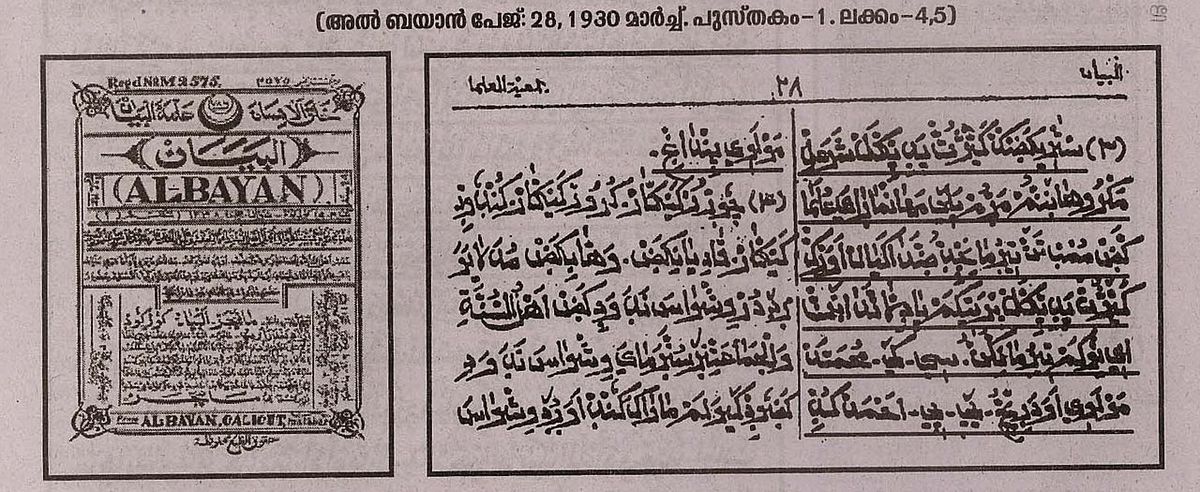
The Arabi-Malayalam tradition is a unique literary phenomenon in Kerala, characterized by the Mappila Muslim community’s practice of writing Malayalam using a modified Arabic script. Originating around the sixteenth century, it served not only as a tool for religious education but also as a vibrant medium for cultural expression, merging elements from Arabic, Persian, and Malayalam. This literary genre spurred the creation of Mappila songs (Mappila Paattu), devotional epics (Mala literature), and historical accounts, thereby shaping a literary identity that intersects faith, local culture, and vernacular creativity. Through its unique linguistic synthesis, narrative artistry, and performative traditions, Arabi-Malayalam highlights an important yet often overlooked aspect of Kerala's history, demonstrating how minority communities balance cultural preservation with literary progress.
Kerala’s literary landscape has historically been defined by multilingual and multicultural interactions. Among these, the Mappila Muslim community developed the Arabi-Malayalam system to bridge the gap between their spoken vernacular and their liturgical language. While initially designed to facilitate Qur’anic literacy and religious education, Arabi-Malayalam transcended functional utility, evolving into a rich literary and performative tradition. This innovation facilitated knowledge transmission among Malayalam-speaking Muslims while creating a distinct cultural identity—one that bridged the oral with the written, and devotional motifs with sociopolitical commentary.
The emergence of Arabi-Malayalam coincided with the height of Mappila maritime trade, exposure to Arabic-Persian literary traditions, and the necessity for vernacular religious instruction. Scholars adapted the Arabic script to represent Malayalam phonetics—creating new letters for sounds not found in Arabic—while incorporating Arabic and Persian vocabulary. This hybridization enabled the community to document religious, poetic, and historical texts, preserving a collective memory of migration, spiritual devotion, and social organization. Significant works such as Muhyuddin Mala, Badar Mala, and various historical chronicles reflect the integration of literary sophistication with cultural preservation, positioning Arabi-Malayalam as a bridge between classical Islamic scholarship and regional linguistic creativity.
Furthermore, Arabi-Malayalam catalyzed profound literary innovation. The adaptation of the script created unique linguistic conventions, while Mappila Paattu and Mala literature introduced new metric and rhythmic patterns. These texts explored themes of spiritual devotion, anti-colonial resistance, and social morality, significantly broadening the thematic horizons of Malayalam literature. Oral recitation and performative practices, such as Duffmuttu and Kolkali, reinforced communal engagement, making this literature a living cultural practice rather than a purely textual phenomenon.
Modern Malayalam literature continues to draw upon this legacy. Writers such as Vaikom Muhammad Basheer and U. A. Khader reflect the narrative sensibilities, humor, and humanism rooted in this tradition. Arabi-Malayalam serves as a compelling case study in multilingual literary adaptation and minority cultural assertion. Its study challenges conventional historiographies that often marginalize Muslim contributions to the Kerala literary canon.
Ultimately, the Arabi-Malayalam tradition exemplifies the synergy of language, religion, and literary innovation. By adapting the Arabic script to Malayalam, the Mappila community created a distinct culture that preserved devotional and historical knowledge while fostering aesthetic creativity. Its enduring influence on poetry and modern prose underscores the significance of minority traditions in shaping regional literatures. Arabi-Malayalam is not merely a historical curiosity; it is a living testament to literature's capacity to negotiate identity, faith, and creativity in a pluralistic society.