
The Living Margins A Conversation on the History and Heritage of Taʿlīqāt in Kerala
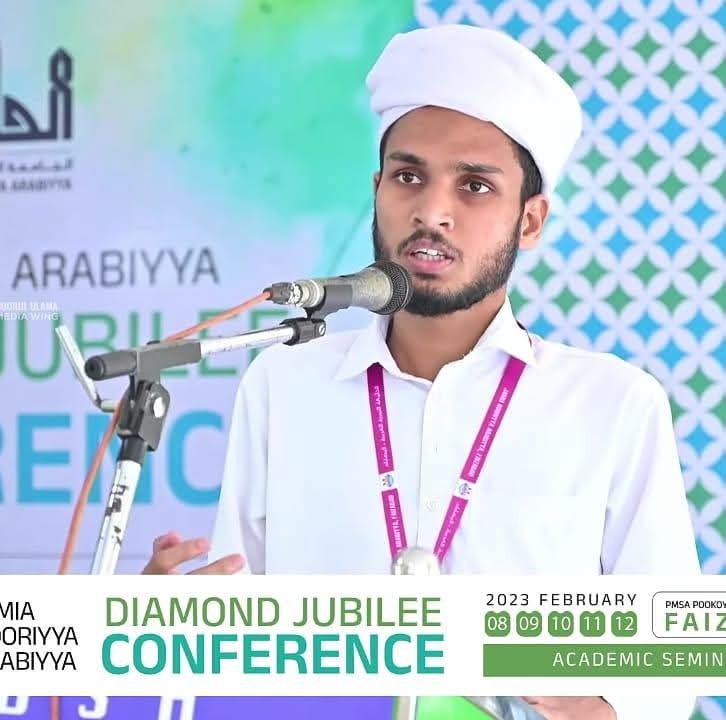
Evident: When we come to the important questions related to Taʿlīqāt, the first thing we must ask about is its history — its origins, the related works of the ʿUlamāʾ, and such foundational matters. Could you speak to the origin and history of Taʿlīqāt in Kerala?
Scholar: In Kerala, the Taʿlīqāt — that is, the scholarly annotations — are in essence what are commonly known in our tradition as Tippanī. The practice of writing annotations for study texts has been seen very widely throughout the history of Darsi education in Kerala. As I mentioned during my talk, we can safely assume that it is as old as the history of the Dars system itself in this field of religious study.
Based on the available historical records, the history of the Dars in Kerala can be traced to Muḥammad ibn ʿAbdullāh al-Ḥaḍramī — a Yemeni native who graduated from Jāmiʿat al-Azhar — who is recorded as conducting Dars at the Valiyukulangara Mosque in Tanūr around 675 AH. This is understood through a record preserved in a work known as Tanbīh. So the practice of Taʿlīqāt, I would argue, is at least that old. Beyond that, precise records have not been obtained to determine exactly when it began.
Furthermore, in the period of Zaynuddin Makhdūm II, it is widely attested that he himself wrote annotations of this nature. What we can also observe from his works is an interesting preliminary method: before beginning to write a book, he would compile the necessary material in the form of notes — much like writing down points for later use. We can therefore assume this tradition carries an antiquity reaching back to the sixth and seventh centuries of the Hijri calendar.
Evident: Among the manuscript materials being preserved and studied in relation to Kerala's Taʿlīqāt tradition, there are two works in particular that have come to our attention: a poetic text known as Alf al-Alf, and a prose treatise entitled Mukhtaṣar al-Iʿlām bi-Qawāṭiʿ al-Islām. Could you tell us something about these works and their place in this tradition?
Scholar: These are precisely the kinds of manuscripts that represent the two faces of this tradition. The Alf al-Alf — and readers should note that this identification should be verified against the manuscript itself before any firm attribution is made — appears to be a didactic poem, a naẓm, composed in accordance with the Kerala practice of versifying complex religious and jurisprudential subjects so that students might memorise and transmit them with ease. The genre of naẓm in Kerala's Darsi tradition was never merely literary; it was pedagogical. Poems of this kind were written upon, annotated in the margins, corrected by later scholars, and handed down as living texts rather than finished monuments. The Tippanī would appear on the sides of such verses precisely because the compressed language of poetry demanded unpacking.
The Mukhtaṣar al-Iʿlām bi-Qawāṭiʿ al-Islām, on the other hand, belongs to an entirely different genre — that of the theological and jurisprudential treatise concerned with the conditions of takfīr, that is, the question of what actions or beliefs constitute a breaking of Islam's boundaries. Again, readers and researchers must verify authorship and attribution from the manuscript itself; I would caution against assuming too quickly. But this genre was a focal point of scholarly controversy in Kerala, particularly because questions of kufr and its boundaries intersected with real disputes happening between scholars and communities. It is no accident that works of this kind attracted Taʿlīqāt from later scholars who wished either to restrict or to extend the positions of the original author.
Evident: What of the forward movement of Taʿlīqāt from that time onwards, and the related changes in the study methods of Kerala? There are accounts of scholars engaging in scholarly refutations through Taʿlīqāt, and of certain works crystallising this genre into a recognised branch of learning. Could you speak to that?
Scholar: If we look at many of the works of the Kerala scholars, in earlier times, they would not waste even a single sheet of paper. It was often on the margins of the books in their possession that they would write these kinds of subjects. We can observe the Taʿlīqāt in Kerala in two distinct ways.
The first is that for a composition by one author, many others in later periods would write annotations upon it. This is the more widely attested form. The second is a method in which the author himself writes annotations for his own composition, to provide clarity to the reader regarding his own words.
In the compositions of Abū Bakr Kuñjikali Thangal, who served as the Valiya Qāḍī of Kozhikode, it is evident that he himself wrote annotations for many of his own works. This includes a poetic text related to the Sīra of the Prophet ﷺ, a work he wrote regarding a controversy related to supplications, and many others. Similarly, his work which may be considered his finest achievement is the Takhmīs of the Witriyya by Ṣadaqatullāh al-Qāhirī Thangal, for which he wrote a Ḥāshiya of approximately seven hundred pages — all with annotations running along the margins of the text. The same method can be seen in the works of Veliyath Kuñjāḥmad Musliyār, who wrote more than one Alfiyya and made annotations upon his own compositions.
The second method — that of disciples and later scholars writing Taʿlīqāt either after the author's passing or during his own lifetime — is equally well attested. We can observe both methods clearly in the tradition.
Evident: When we look at manuscripts such as the Alf al-Alf, we observe that the annotations surround the main text from all sides — the margins above, below, and beside the verses are filled with another hand entirely. What does this physical arrangement tell us about how these scholars actually worked?
Scholar: It tells us a great deal. The page itself was a workspace, not a display case. The practice of writing in the margins was not decorative; it was functional and urgent. A scholar receiving a text would often be responding to it in real time — he would read a verse or a legal statement, immediately encounter a difficulty or an objection or a supplementary reference, and write it down before it was lost. This is why the handwriting in the Taʿlīqāt manuscripts is often compressed, hurried even, compared to the more careful hand of the main text.
What is also noteworthy is that the language of the Taʿlīqāt often switches in register. Where the main text may be in formal Arabic, the annotation beside it might move into a more colloquial Arabic, or occasionally reference a local term or example relevant to Kerala specifically. This is how we can trace the localisation of Islamic learning — the universal text of the Shāfiʿī tradition being actively domesticated and applied to the conditions of this land by scholars who were simultaneously students and teachers.
In the case of a didactic poem like the Alf al-Alf, the annotations would typically explain a difficult word or phrase, clarify which legal opinion the verse was summarising, or note a variant reading. For a prose treatise like the Mukhtaṣar al-Iʿlām bi-Qawāṭiʿ al-Islām, the annotations would more often engage with the argument itself — whether to affirm it, qualify it, or register a dissent. These are two entirely different modes of Taʿlīq in practice.
Evident: There are accounts of scholars engaging in intellectual disputes through these annotations — could you elaborate on some such instances?
Scholar: In the annotations of Kuñjikali, we can indeed see instances of these intellectual debates. There was a significant controversy during his time regarding whether it is permissible to supplicate 'Allāhummaghfir lahu warḥamhu' and similar phrases in relation to the Prophet ﷺ. Abū Bakr Kuñjikali Thangal viewed such supplications as a form of discourtesy. When a prominent scholar of the Muchundi Mosque in Kozhikode issued a fatwā contrary to his view, Kuñjikali wrote a book of approximately two hundred pages as a refutation. Beyond that principal text, we can see accompanying Taʿlīqāt.
Similarly, disputes arose among the ʿUlamāʾ of Ponnanī regarding the translation of Ṭalāq and the distinction between the Ṣarīḥ and Kināya forms within it. ʿAbd al-ʿAzīz Makhdūm, the son of Valiya Makhdūm, held a view said to be contrary to that of his father, Zaynuddin Makhdūm Kabīr. The great Shihābuddīn Aḥmad Koya Shāliʾāthi Thangal, rejecting the view that was contrary to the position of the Qāḍīs of Kozhikode, wrote a work entitled Fatāwā Qaṣīdat al-Azhariyya fī Tarjamat al-Ṭalāq. In all of these controversies, we find Taʿlīqāt of this nature embedded in or alongside the principal texts.
The Mukhtaṣar al-Iʿlām bi-Qawāṭiʿ al-Islām is itself a work engaged in one of the most sensitive of these debates — the question of when and how a Muslim may be judged to have left the fold of Islam. The fact that a 'mukhtaṣar', that is, an abridgement, was made of a larger work on this subject tells us that the original text was important enough to condense and transmit. It also tells us that this was not an abstract theological exercise; it was a practically relevant question for judges, scholars, and communities who needed guidance on such matters. Taʿlīqāt upon a work of this kind carry an especially weighty responsibility.
Evident: Would there not be mutual refutations among the scholars of Kerala — one scholar writing, and others joining to refute one another through their Taʿlīqāt?
Scholar: That particular phenomenon — of successive and mutual refutations through Taʿlīqāt specifically — has not been observed much. The Taʿlīqāt, by nature, appears in the margin of a text. In the additional subjects written beyond the main text, it can be seen in the manner of the controversy mentioned involving Abū Bakr Kuñjikali. But I have not noticed it occurring much in a pattern of sustained mutual refutation through the Taʿlīq form specifically. The refutations between scholars more typically took the form of independent treatises — a Risāla, a Fatwā, a full Radd — rather than marginal annotation. The Taʿlīq was more often a commentary than a combat.
Evident: One concern that comes up when studying manuscript traditions of this kind is the question of lost works — annotations that were never copied, or whose attribution was forgotten. How serious is this problem in Kerala's Taʿlīqāt heritage?
Scholar: It is very serious, and it is something that deserves far more attention than it has received. As I have mentioned before, the Kerala scholars of earlier generations did not always record their names prominently on their Taʿlīqāt. There was a degree of scholarly humility in this — the annotation was understood as a service to the text and to the student, not as a vehicle for personal recognition. The consequence of this is that we now have manuscripts in which the main text is clearly identified, but the annotations are entirely anonymous.
There is also the question of survival. Many of the Taʿlīqāt existed only on the margins of specific physical copies — not as independent works at all. When those copies were damaged, lost to moisture or insects, or simply discarded as old, the Taʿlīqāt went with them. What has survived to us represents only a portion of what was produced. Manuscripts like the Alf al-Alf and the Mukhtaṣar al-Iʿlām bi-Qawāṭiʿ al-Islām that have come into the possession of researchers today should therefore be treated as precious remnants — but researchers must exercise great care in reading, attributing, and publishing them. Verification before attribution is not optional; it is an obligation.
Evident: When we look at the background of Kerala, the scholars most prominently associated with the Taʿlīqāt tradition are Sayyid ʿAlī Musliyār and Karinkappara Muḥammad Musliyār. Could you speak to their contributions and the growth of Taʿlīqāt in that context?
Scholar: The Taʿlīqāt in Kerala are primarily written upon the works that are taught most widely in our Darsi tradition — the kitābs that fall under the Makhdoomī syllabus. In the field of jurisprudence, Fatḥ al-Muʿīn and Umdat al-Sālik are primary, along with the ten texts known as the Mutafarridāt and Nūr al-Abṣār. Although Taʿlīqāt exist in some form upon all of these, the main concentration is upon Fatḥ al-Muʿīn.
In the field of grammar, the works annotated include Taqwīm al-Lisān, Mīzān, Ajnās, ʿAyn al-Hudā — which is a commentary on Qaṭr al-Nadā — and similarly the commentary on the Alfiyya by Makhdūm Kabīr. There are also many Taʿlīqāt upon the Jāmiʿ, such as those of Sayyid ʿAlī Musliyār. In the fields of Taṣawwuf and Uṣūl al-Dīn, these annotations appear on texts such as Sharḥ al-ʿAqāʾid and ʿAqāʾid al-Nasafiyya.
Sayyid ʿAlī Musliyār and Karinkappara Muḥammad Musliyār were contemporaries who studied together under Valiya Koyakutti Musliyār. As printing became more active in Kerala, it was the press operators who began collecting these Taʿlīqāt and printing them in the margins of the kitābs. The Taʿlīqāt that were produced in the greatest quantity and gained the widest popularity in Kerala were those of Sayyid ʿAlī Musliyār and Karinkappara Muḥammad Musliyār. The sheer breadth of their circles of students was perhaps the principal reason for this.
Evident: When those press operators began printing the Taʿlīqāt alongside the main text, did that change the nature of the tradition itself? There is a difference, presumably, between a handwritten annotation in a personal copy and the same text set in type and distributed widely.
Scholar: That is a perceptive observation, and yes — the shift from manuscript to print did change the tradition in important ways. The handwritten Taʿlīq was by nature contextual. It existed in dialogue with a specific copy of a text, often a specific teacher's copy, and it carried the traces of a particular pedagogical relationship. When a student received a kitāb that had been annotated by his own teacher, those annotations were not merely informational — they were also personal, carrying the voice and judgment of a man he had known and sat before.
When those same annotations were typeset and printed uniformly in the margins of mass-produced editions, something was inevitably standardised. The annotation was no longer one scholar's response to one text in one moment; it became fixed, authoritative, and somewhat detached from the living tradition that had produced it. This is not entirely negative — print meant that Taʿlīqāt, which might otherwise have survived only in a few personal copies, became available to thousands of students across Kerala. But it also meant that the more idiosyncratic, experimental, or locally specific annotations were often left behind, as press operators naturally selected for the most widely accepted and least controversial material.
Evident: How do you view the standing of this tradition today?
Scholar: In the new digital age, the old relevance of these Taʿlīqāt is no longer what it once was. As translations and explanations of Arabic kitābs became abundantly available in Malayalam, students began to rely more on those translations and on published Sharḥs rather than on the traditional Taʿlīqāt. Because the authorship was often not accurately recorded, many of these annotations have come down to us without any clear attribution. Some Taʿlīqāt are also very lengthy, and a common complaint heard from students is that they no longer have the time to read and study them properly.
What I would say is that this is a moment that calls for serious archival and editorial work. Manuscripts like those being brought forward now — works such as the Alf al-Alf and the Mukhtaṣar al-Iʿlām bi-Qawāṭiʿ al-Islām — should be properly examined, attributed with all due caution, edited with scholarly rigour, and made accessible. This is a responsibility that falls on the institutions of learning in Kerala, and on those scholars and researchers who still have the training to read these manuscripts and understand their context. The tradition is not dead, but it requires dedicated custodians if it is to survive.