
The Mechanism: Fixed Core, Fluid Margins
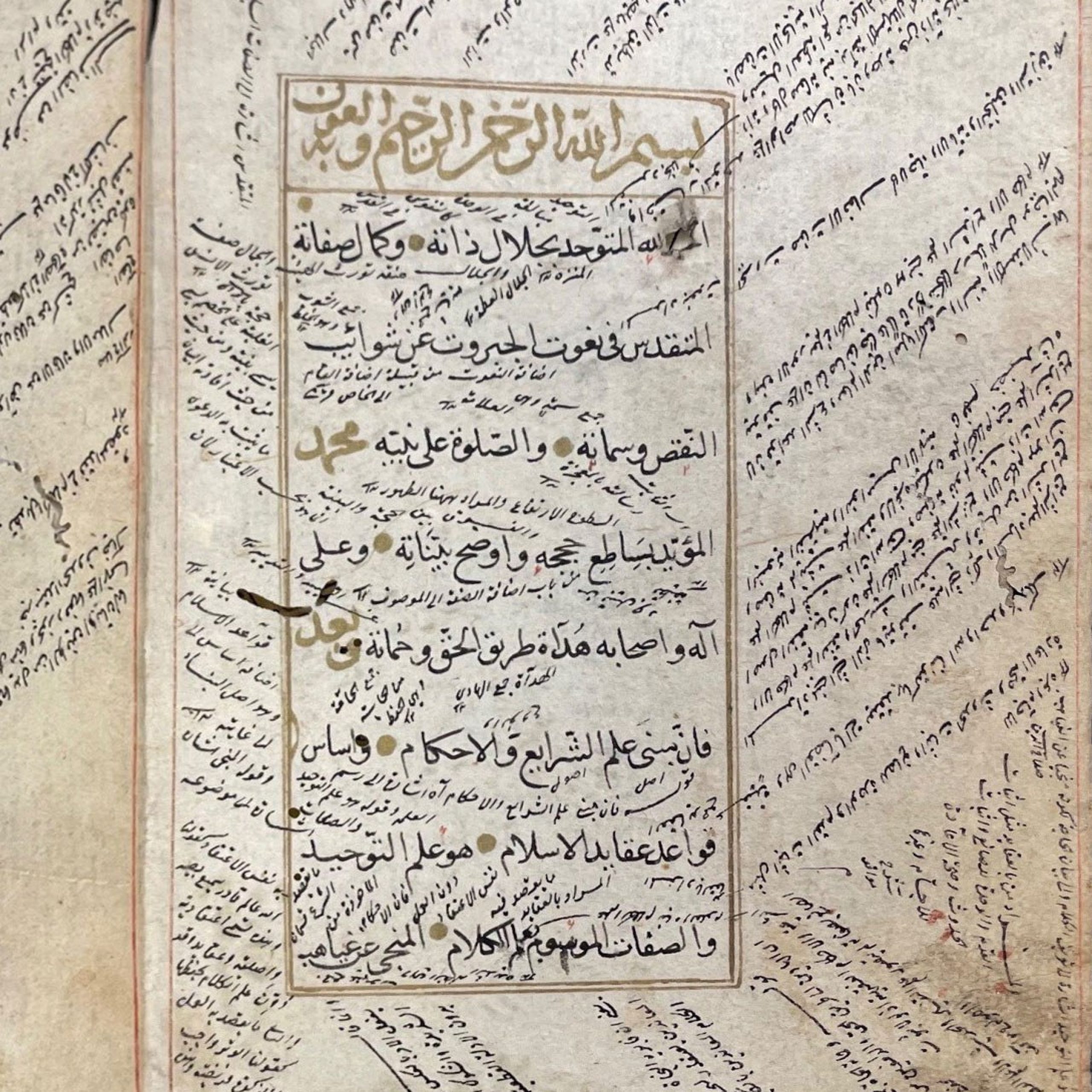
Historically, the Orientalist perspective on marginalia, specifically Hashiya and Ta’liqat, asserted the intellectual stagnation of Islamic scholarship. This critique argues these texts undermined scriptural foundations, creating redundant commentary traditions. However, modern research contests this, highlighting how commentaries functioned as periscopic tools, adapting theology and jurisprudence to evolving historical contexts.
Their practical authority was recognized by colonial translation movements, which utilized them as foundations for legal blueprints, marking a paradigm shift in administrative precedents. German scholars translated Al Bajuri's nineteenth-century Hashiya, viewing it as the authoritative application of Shafi'i law. Similarly, in British India, texts like the Hidayah were translated for judicial purposes because they represented the era's living law.
Before the printing press, knowledge was transmitted through Ijazah and Sanad. Within this framework, commentaries endorsed authenticity, rooting transmission in primary synthesis. Zakariyya al Ansari's engagement with Jam' al Jawami' exemplifies this; he produced summaries, wrote commentaries, and added marginal notes. This multiplicity of works on a single text illustrates how intellectual traditions remained vibrant.
In the twentieth century, scholarly focus shifted from Ta’liqat to Tahqiq. Ahmed Shakir edited the Risala and Musnad Ahmad to render them accessible. This transition represented discourse maturation, not exhaustion. Tahqiq allowed the tradition to meet bibliographic standards while maintaining its historical link. Shakir’s work reasserted the Sanad’s relevance in mechanical reproduction. Applying rigorous philological methods, scholars transformed layered traditions into a streamlined corpus compatible with the modern state.
The pedagogical utility of the Hashiya provided a structured curriculum, democratizing legal thought. In Ottoman and Mughal systems, progressing from Matn to Sharh and Hashiya mirrored cognitive development. This ensured students engaged with historical disputes and evolving logic, rather than memorizing law. Orientalist critiques missed this pedagogy, mistaking depth for repetition.
Today, the legacy of these texts informs fields like Islamic finance and modern family law. Ibn Abidin's Hashiya remains a primary Hanafi reference because it addresses complex issues using classical scaffolding. This adaptability proves that the commentary tradition was the primary engine of Islamic legal evolution. Ultimately, the shift to Tahqiq provided the final necessary tool: a verified, accessible library of this evolutionary process, stripping away transcriptive errors to reveal the sophisticated intellectual engineering beneath. Thus, the trajectory from early Ta’liqat to modern volumes is one of continuous refinement.